



This week all the major AI news came out of Google’s I/O 2026, where they announced a huge range of new AI models and AI-powered products and capabilities. There was a lot to take in so I’ve covered everything I thought was important in this week’s newsletter. There was also a great new video from Boston Dynamics showing off Atlas’ ability to lift a fridge!
As you can imagine, there was lots of Google news that related to Web 4.0 as well, with the most notable one being their new Universal Cart that will follow you across the internet.
There was lots of Ethics News too and it’s worth checking out the two Long Reads this week as well with a great article from Simon Willison on The last six months in LLMs.
Was there anything at Google I/O 2026 that didn’t include AI?!
Google held its annual I/O event this week and everything it announced was related to AI in one way or another. There was a huge amount of new things that they covered, which was difficult to follow at times, but The Verge has a great summary of the 13 biggest announcements at Google I/O 2026 you can check out if you’re interested in the headlines.
The big things I’d highlight are:
The announcement of A new era for AI Search that I cover below in more detail
The release of a new family of models, Gemini Omni that I go into in more detail below
The release of Gemini 3.5 Flash, which is focused on powering AI agents, that I go into more detail below
Gemini Spark, Google’s take on OpenClaw, which is coming soon
An upgrade to the Genie world model which can now simulate real streets with Street View
I’m sure we’re be learning a lot more about all of this over the coming weeks as things are released and people get to go hands on. A lot was covered at I/O so I’ll do my best to cover the important things in more detail below!
A new era for AI Search
At I/O, Google shared a slick marketing video positioning its latest Search announcements as the beginning of a new era for AI search. They clearly want Search to become more conversational, more agentic, more personal, and less dependent on the traditional list of blue links.
But the reality isn’t quite as dramatic. The biggest live change is an upgrade to the model powering AI Mode, which most people probably won’t notice, while the more ambitious features, including search agents, agentic booking, generative UI, and mini-apps, are either coming this summer or rolling out first in the US and/or to paid Google AI subscribers. So this is unlikely to transform the everyday search experience for most people overnight.
The important distinction is that most of these changes are coming to AI Mode, not necessarily to the default Google Search experience. AI Mode is Google’s dedicated conversational search interface, and while Google is clearly creating more routes into it from standard Search, that is not the same as replacing the core search experience for everyone.
Gemini Omni will create anything from anything
Gemini Omni follows the same direction of travel we’re seeing across AI image, video and coding tools: combining reasoning with generation so the model can understand intent, not just produce an output. With Omni, you can combine images, audio, video and text as inputs to generate videos grounded in Gemini’s real-world knowledge.
For example, you can take an existing video and ask Omni to change a specific part of it, like turning a sculpture into bubbles, making a mirror ripple like liquid when someone touches it, or transporting a violinist into a completely different visual environment while keeping the character and action consistent. Users can then iterate, with each new instruction building on the last.
According to The Verge, Google’s new anything-to-anything AI model is wild
The first version of Gemini Omni, the Flash model, is now available to Google AI Plus, Pro and Ultra subscribers. It can currently create 10-second videos, with image and audio outputs still to come.
Content generation is starting to shift from prompting to directing, in the same way coding has shifted recently from writing code to managing coding agents. Instead of describing a finished asset from scratch, you can bring Gemini a set of references, existing assets and half-formed ideas, then shape the output through conversation. That feels much closer to how AI-assisted creative tools should work.
YouTube | TechCrunch | Google
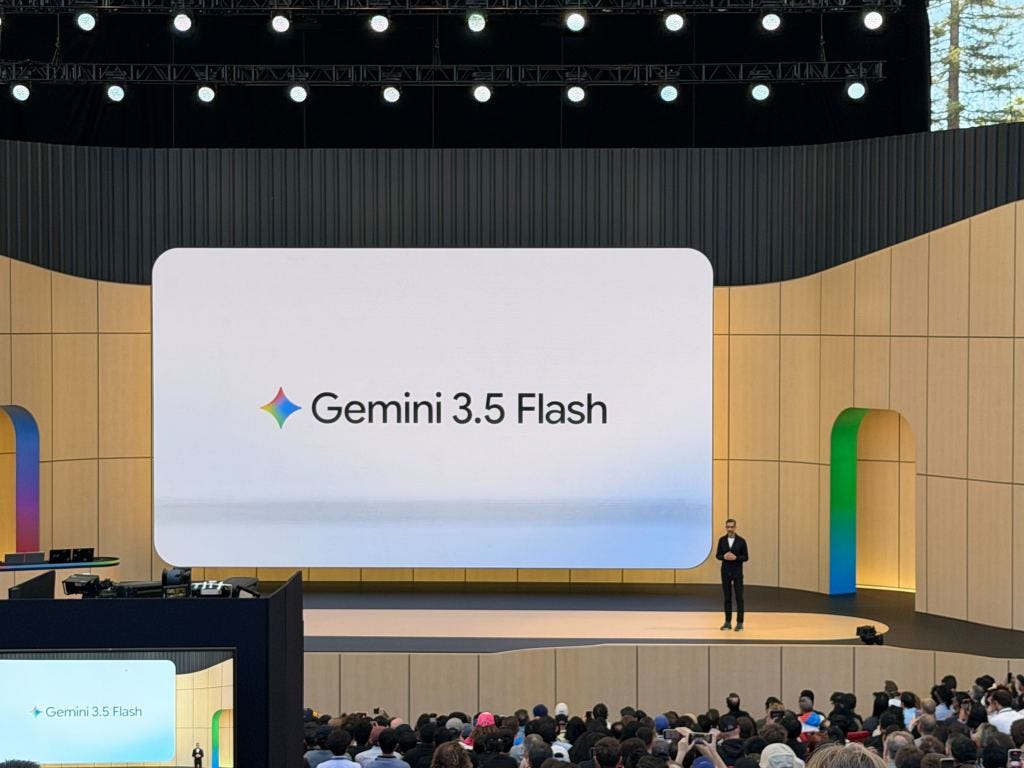
With Gemini 3.5 Flash, Google bets its next AI wave on agents, not chatbots
Gemini 3.5 Flash is Google’s latest flagship model, and the company is now explicitly positioning it around agentic work: coding, tool use, long-running workflows, subagents and enterprise tasks that need speed as much as intelligence.
That focus on speed feels important. I use coding agents a lot, and latency is still one of the biggest areas where the experience needs to improve. So far, most of the conversation around frontier AI models has focused on intelligence and cost, but agents add a third requirement: speed.
That matters because agents do not just answer a question once. They reason, call tools, write code, inspect results, make changes, run checks and sometimes split work across multiple subagents. Once models are doing that kind of multi-step work, waiting for the next token becomes part of the product experience.
Atlas, can you bring me a drink?
Great new Atlas video from Boston Dynamics that shows Atlas picking up a whole fridge. This is the first time I’ve seen a humanoid robot use its whole body to lift something, like people do when lifting heavy objects. There’s a nice behind the scenes video of how they trained it to do this here if you’re interested.
Web 4.0
Google’s new Universal Cart wants to follow you across the entire internet
Gemini will use Volvo’s external cameras to interpret parking signs
Google launches AI marketing assistant as it expands search and agentic commerce advertising options
AI Ethics News
Billionaires are trying to lull us into AI complacency. Don’t let them
Steve Bannon Petitions Trump to Review New AI Models Before Their Release
Anthropic to share Mythos cyber flaw findings with global finance watchdog
OpenAI says it’s getting serious about AI detection and labeling
More than 100 UK datacentres plan to burn gas to generate electricity
University of Arizona students boo Eric Schmidt’s AI cheerleading during commencement
ChatGPT and other AI bots made huge errors before Scottish election, study finds
Google DeepMind in talks with UK unions amid staff concern over US and Israel’s AI use
An OpenAI model has disproved a central conjecture in discrete geometry
Long Reads
Simon Willison - The last six months in LLMs in five minutes
Person Familiar - AI, “Humanity”, and Dr. Manhattan Syndrome
“The future is already here, it’s just not evenly distributed.“
William Gibson