


As is becoming the norm in the generative AI space, it’s been a busy end to the year! This week Google launched Gemini 3 Flash, OpenAI launched a new Image model as well as an App Store for ChatGPT. There was also a great video on why we should be focused on building skills for agents instead of building multiple agents that I thought was worth sharing.
In Long Reads its worth checking out Ethan Mollick’s article on The Shape of AI: Jaggedness, Bottlenecks and Salients and Charlie Guo’s AI Trends for 2026.
That’s a wrap from me for 2025 - I’ll be taking a week’s break over the festive period and so the next newsletter will land on the first Sunday of the new year. 2026 is shaping up to be another busy and fascinating year!

Gemini 3 Flash: frontier intelligence built for speed
Quickly following the launch of Gemini 3 Pro we now have the Flash variety and it’s an impressive model that outperforms Gemini 2.5 Pro while being 3x faster. Gemini 3 Flash is able to modulate how much it thinks but it also uses 30% fewer tokens on average than 2.5 Pro.
I have to say that the speed of the Gemini 3 family of models is incredibly impressive and probably something only Google can pull off at this point, with the huge amount of cloud infrastructure they have at their disposal. For every day use cases, I think this is a much bigger deal than the general intelligence of a model as all the frontier models are now ‘good enough’ at ‘most things’.
Despite having a relatively quiet year, especially compared to OpenAI, Google have finished on a huge high and as we head into 2026 they are definitely ahead with the fastest and most capable generative AI models.
OpenAI’s new flagship image generator AI is here
OpenAI continues its response to Google’s recent releases with the launch of a new Image model for ChatGPT. Tellingly, this is GPT Image 1.5, so not a full version release, so there is more to come. In the meantime, this new Image model is better at following instructions, which allows it to be much better at editing images, and it’s also up to 4x faster at image generation.
I’m not sure I quite agree with OpenAI’s claims that it’s “more like a creative studio.” but it’s great to see continued improvements in this space.
Don’t Build Agents, Build Skills Instead
2025 was definitely hyped to be the ‘year of AI Agents’ but I still think we’re too early in the development of the technology to really be able to claim that. The thinking around how Agents are built, shared, and used has certainly moved on though and a large majority of this work is being done by Anthropic.
Anthropic released Model Context Protocol (MCP) just over 12 months ago and it quickly became the industry standard for how AI Agents interact with other technologies. A couple of months ago they released a new standard for AI Agents called ‘Skills’, which are likely to become an even bigger deal.
To summaries, 12 months ago everyone thought they’d need to build specialised Agents for different tasks. Turns out that a better approach is you can have one general agent that has lots of specialist skills. You might ask what the real difference is, but it turns out to be a lot! Agents are hard to build, Skills are incredibly easy to build - anyone can do it really with a little help from an AI model.
So I think 2026 will be the ‘year of AI Skills’ and if you’re interested in learning more, the short video above is well worth a watch.
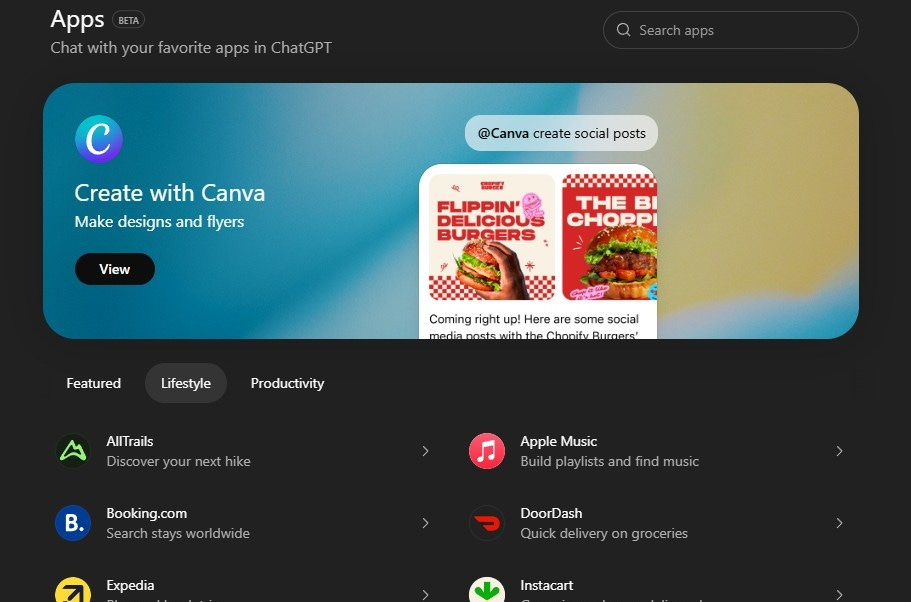
The ChatGPT App Store is here
I’ve started writing recently about how OpenAI wants to rebuild the internet inside ChatGPT, and this is a big piece of that puzzle. With the launch of the ChatGPT App Store, not only are major digital services now available inside of ChatGPT, but it makes the chat interface itself a much more vibrant and interactive experience.
All of the Apps available inside ChatGPT’s App Store are understandably very basic to start off with and are mostly ‘read-only’. The Apple Music app, for example, can’t list any of the music in my library and it can’t play more than a short preview of any song. But it can suggest songs, create a playlist, and tell you which of the songs it’s selected are already in your library, and allows you to add songs to your library. Not a bad start.
There are good showings from Adobe, Google, and Microsoft in ChatGPT’s App Store and as you can imagine, there are lots of productivity and ‘lifestyle’ apps. Developers can now submit apps to ChatGPT’s App Store for approval so I expect this ecosystem to get built out over the course of next year. I fully expect many major digital services to have a ChatGPT App next year, and it will be interesting to see how consumer adoption goes.
Web 4.0
Mozilla’s new CEO says AI is coming to Firefox, but will remain a choice
Google wants its AI assistant CC to replace your morning scroll
OpenAI Defaults Free Users to Cheapest Model to Cut Back on Costs
AI Ethics News
AI boom has caused same CO2 emissions in 2025 as New York City, report claims
Boost for artists in AI copyright battle as only 3% back UK active opt-out plan
Long Reads
One Useful Thing - The Shape of AI: Jaggedness, Bottlenecks and Salients
Artificial Ignorance - AI Trends for 2026
Fidji Simo - The shift from text to more dynamic AI experiences
The Guardian - What will your life look like in 2035?
“The future is already here, it’s just not evenly distributed.“
William Gibson