


Another quiet week on the AI front, if you discount some of the crazy AI-related announcement at CES! Although in all seriousness, I think unlike last year we are starting to see some genuinely useful applications of AI now coming through. OpenAI also launched ChatGPT Health this week, and Boston Dynamics showed off their production-ready version of Atlas which is very exciting!
There was a small amount of ethics-related news, and obviously the big headlines are around the terrible and in-defensible image generating capabilities of Grok.
In Long Reads there are some more good wraps ups of 2025 and looks ahead to 2026 worth checking out. Great article from Stratechery on AI and the Human Condition as well.
Best of CES 2026
Just like last year, AI was being thrown at everything at CES 2026. But this year felt like a turning point. Instead of AI features awkwardly bolted onto kitchen appliances, we’re seeing AI embedded into products where it kind pf makes sense: smart scales focused more on long term health, robot vacuums that can finally climb stairs, and autonomous driving systems that handle real-world chaos in San Francisco.
There were lots of other interesting products announced at CES and top among them were the AI companions. Ecovacs’ Lil Milo is a fluffy robot dog that does essentially nothing except react to your presence and develop a personality over time. It joins products like Zeroth’s WALL-E-inspired W1 and Fuzozo’s purring puffball in a growing category of machines designed for little purpose beyond existing. If these companies are to be believed, AI should start leaving our screens and take on a physical and emotional presence in our lives.
I said last year that it takes humanity a while to catch up and work out what to do with new technology. CES 2026 suggests we’re finally getting there. The use cases for AI are just about starting to crystallise, and they’re not always what we expected. Some are practical, some are emotional, and some are still a bit questionable. But the gap between hype and meaningful implementation is definitely narrowing.
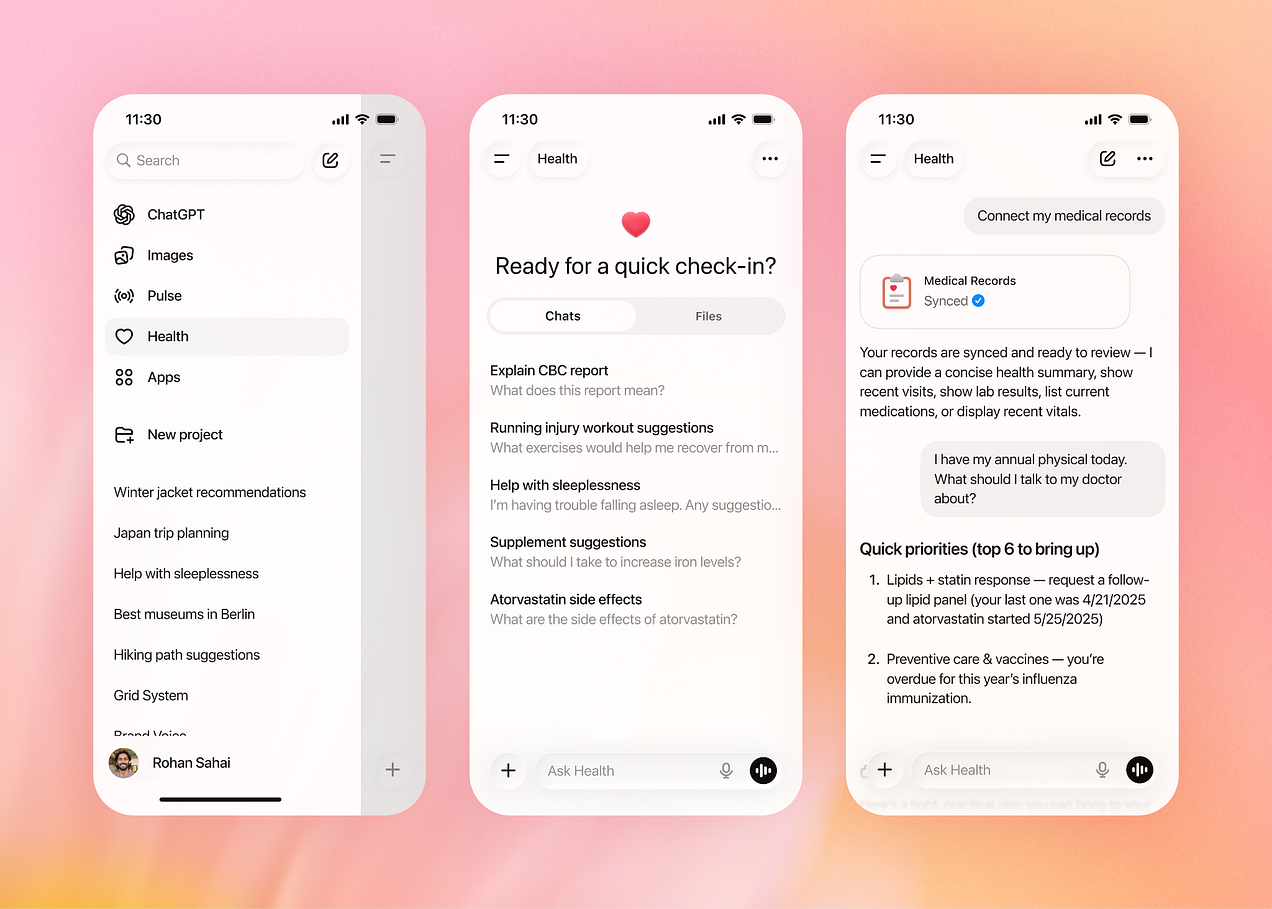
OpenAI launches ChatGPT Health, encouraging users to connect their medical records
People have been using ChatGPT for health queries ever since it launched, and today over 230 million people ask health-related questions every week. But individual conversations are very different from a dedicated health experience with connected medical records, which is much harder to secure, regulate, and deploy responsibly.
This week OpenAI announced ChatGPT Health, which is a separate encrypted space within ChatGPT where you can connect medical records, and platforms like Apple Health, for personalised health guidance. The initial rollout excludes the UK, EEA, and Switzerland entirely, which highlights that OpenAI have more work to do with the regulators in these regions.
Whilst OpenAI collaborated with 260+ doctors in the development of ChatGPT Health, it isn’t HIPAA compliant and they avoided mentioning mental health despite the documented risks and recent headlines. There’s been lots of research showing how AI models can benefit healthcare, but the challenge is really with the regulators and whether they can keep up with the pace of change.
Boston Dynamics’ Tesla Bot rival Atlas will start building Hyundai cars in 2028
Boston Dynamics have been at the forefront of robotics for the last 35 years and they’ve had lots of success with the commercialisation of Spot over the last 5 years. But Spot isn’t a bipedal humanoid robot, which is much harder to develop, produce at scale and commercialise.
I’ve been very excited about Atlas since Boston Dynamics announced that they were moving away from hydraulics to a fully electric version nearly two years ago. I knew it would take them a while to dial in how to mass produce the new version of Atlas, and I have to say that I absolutely love what they shared this week in the video above. The production version of Atlas looks fantastic, and the ambition to manufacture 30,000 of them per year from 2028 is impressive.
I don’t think we’re going to really see and feel the impact of humanoid robotics until around 2030, but it’s definitely coming and its going to be fascinating to watch how it all plays out.
Web 4.0
AI Ethics News
‘Dangerous and alarming’: Google removes some of its AI summaries after users’ health put at risk
Leading AI expert delays timeline for its possible destruction of humanity
Google and Character.AI negotiate first major settlements in teen chatbot death cases
OpenAI is reportedly asking contractors to upload real work from past jobs
Long Reads
Stratechery - AI and the Human Condition
Simon Willison - LLM predictions for 2026
One Useful Thing - Claude Code and What Comes Next
Ignorance.ai - 10 AI Stories That Shaped 2025
“The future is already here, it’s just not evenly distributed.“
William Gibson